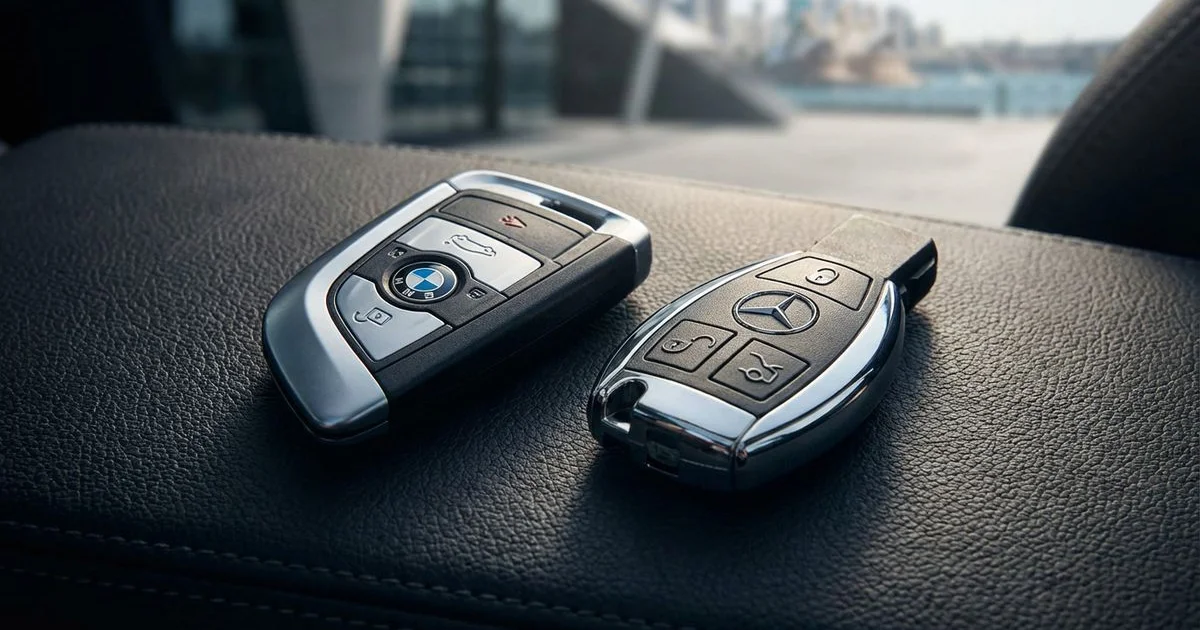
BMW and Mercedes Key Systems: A Detailed Guide for Owners
Getting locked out of your high-performance vehicle is more than just an inconvenience. We see the panic set in every day across Sydney when a driver realizes their key isn’t responding.
The technology inside these keys is impressive. But that same sophistication is exactly what makes a sudden failure so stressful.
You might be standing in a parking lot wondering why your car won’t start despite having a fresh battery.
Our team of European car locksmith specialists resolves these specific high-security deadlocks.
We want to help you understand what is actually happening between your key and your car’s computer. This guide breaks down the specific systems, common failure points, and the most efficient ways to get back on the road.
BMW Key Systems Explained
BMW has consistently pushed the boundaries of vehicle security over the last twenty years. Each generation of their security platform introduces tighter encryption and new hardware requirements.
EWS (Electronic Immobiliser System) — 1995 to 2004
The EWS system was the foundation of modern BMW security. It relies on a specific “rolling code” protocol that changes every time you start the car. The key contains a transponder chip that talks to a control module under the dash.
Vehicles: E36 (3 Series), E46 (3 Series), E39 (5 Series), E38 (7 Series), E53 (X5)
Key characteristics:
- The “Diamond” Shape: Most keys from this era have the distinctive diamond-shaped head.
- Rolling Code Sync: The code changes after every start. If you try to start the car with a low battery too many times, the key and car can go out of sync.
- Rechargeable Batteries: These keys charge while in the ignition. A non-working remote often just needs a new VL2020 battery soldered in.
- EWS Module Limits: The module can only store 10 unique key identities before it must be replaced or reset.
CAS (Car Access System) — 2004 to 2014
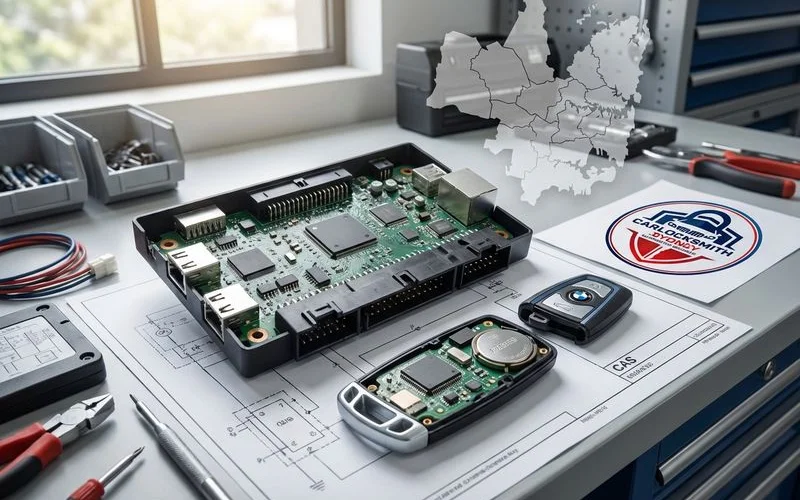
This system represents a significant jump in technical sophistication. We find that CAS modules are the most common failure point for BMWs from this era due to their integration with multiple vehicle systems. The CAS controls the engine immobiliser, the central locking, and the physical starter motor.
Versions:
- CAS1: Found in early E60 (5 Series) and E65 (7 Series).
- CAS2: Common in the E90 (3 Series) and pre-facelift E60/E70 models.
- CAS3/CAS3+: The standard for most models between 2007 and 2013.
Key characteristics:
- Comfort Access: This feature allows keyless entry but drains key batteries faster (usually a CR2032).
- ISN Pairing: The key contains a 128-bit secret key (ISN) that must match the engine computer (DME) exactly.
- Ribbon Cable Failures: The buttons on these smart fobs often stop working because the internal ribbon cable cracks from age.
- All Keys Lost Complexity: If you lose every key, the CAS module typically requires bench-programming to extract the ISN data safely.
FEM/BDC (Front Electronic Module / Body Domain Controller) — 2014 to Present
Modern BMWs use the FEM or BDC architecture. These are massive control units located in the passenger footwell that manage hundreds of functions.
Vehicles: F30 (3 Series), F10 (5 Series), G20 (3 Series), G30 (5 Series), all current X models
Key characteristics:
- Location Vulnerability: Because the FEM is located in the kick panel, it is highly susceptible to water damage if the sunroof drains clog.
- Dealer Server Requirement: Programming these keys often requires a secure connection to BMW’s central servers.
- Frequency Specifics: Australian models typically run on 433MHz. Importing a key from the US (315MHz) will result in a remote that starts the car but won’t lock the doors.
- Digital Integration: Newer G-series models support Digital Key Plus using Ultra-Wideband (UWB) technology on smartphones.
Mercedes-Benz Key Systems Explained
Mercedes-Benz utilizes a proprietary system that is fundamentally different from other manufacturers. Their “DAS” (Drive Authorization System) checks for authentication before the key can even turn in the lock.
EIS/EZS (Electronic Ignition Switch / Elektronisches Zundschloss)
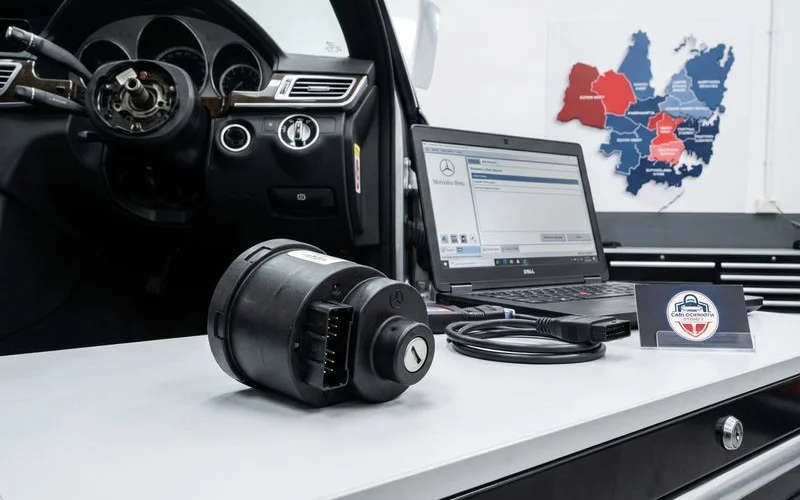
The ignition switch in a Mercedes is actually a complex computer. It powers the key inductively and reads data via infrared light.
How it works:
- Inductive Power: Inserting the key sends a magnetic pulse that powers up the key’s processor (even if the key battery is dead).
- Infrared Handshake: The key sends a data stream via IR to the ignition switch.
- Hash Verification: The EIS calculates a “hash” result. If it matches the stored value, it unlocks the steering.
- Engine Authorization: Only after the steering unlocks does the EIS tell the engine computer to allow fuel and spark.
Common EIS generations:
- W203/W211 EIS: Standard on C-Class and E-Class (2000-2009). Known for cold-weather failures.
- W204/W212 EIS: Used in 2008-2015 models. Generally reliable, but the steering lock connected to it is not.
- W205/W213 EIS: Current generation (FBS4 system). Extremely difficult for third-party repair.
The Infrared Problem
Communication relies entirely on line-of-sight infrared signals. We frequently see keys that fail because the plastic lens on the tip is scratched or dirty.
Pro Tip for Owners: You can test your key yourself using a smartphone camera.
- Open your phone’s camera app.
- Point the tip of the key at the lens.
- Press and hold a button.
- If you see a faint purple or white light on your screen, the key is transmitting. If not, the key is likely dead.
Symptoms of IR failure:
- Key works intermittently or requires “wiggling.”
- Remote buttons unlock the doors, but the car won’t start (these are separate antennas).
- No “clunk” sound when inserting the key into the dashboard.
ESL (Electronic Steering Lock) Failures
The Electronic Steering Lock (ESL) is a mechanical servo motor that physically locks the steering wheel. This is the single most common “no start” cause for the W204 C-Class and W212 E-Class.
The “Silent” Symptom: Normally, you hear a distinct mechanical zip-clunk sound when you insert your key. If you insert the key and hear absolute silence—but the radio and lights still work—your ESL motor has likely seized in the locked position.
Why this matters: A dealership may quote you for a full steering column replacement. We often solve this by installing an emulator. This electronic device mimics the signal of a working lock, permanently bypassing the prone-to-fail mechanical motor.
What Makes These Systems Technical to Work With
ISN Alignment (BMW)
BMW security relies on a rigorous digital handshake. The CAS/FEM module and the Engine Control Unit (DME) must share a matching Individual Serial Number (ISN).
The Challenge: If you buy a used engine computer from a wrecker, your car will not start. Our technicians must use specialized ECU immobiliser programming software to “virginize” the replacement module or read the ISN from the old unit and write it to the new one. This ensures the digital handshake succeeds.
EIS Repair vs Replacement (Mercedes)
You have two distinct paths when a Mercedes ignition module fails.
Option 1: EIS Repair This process involves us removing the module, desoldering the Motorola processor inside, and repairing the corrupted data files.
- Pros: Keeps your original keys working.
- Cons: Takes 24-48 hours.
Option 2: EIS Replacement This involves installing a brand-new unit.
- Pros: Factory reliability.
- Cons: Much more expensive and renders all your old keys useless until they are reprogrammed.
Coding and Adaptation
Modern keys are not “plug and play.” After the security programming is done, we must code the key to match your vehicle’s specific options.
- Profile Settings: Seat positions and mirror angles linked to the specific key number.
- Remote Functions: Whether one click unlocks all doors or just the driver’s door.
- Comfort Features: Windows rolling down when the unlock button is held.
Cost Overview for Sydney Owners
Pricing for European key replacement fluctuates based on chip availability and software licensing fees. The following tables provide a realistic estimate for the Sydney market in 2026.
BMW Key Replacement Costs
| Vehicle Generation | Scenario | Estimated Cost (AUD) |
|---|---|---|
| EWS (Pre-2004) | Spare Key | $300 - $500 |
| All Keys Lost | $500 - $800 | |
| CAS (2004-2014) | Spare Key | $450 - $700 |
| All Keys Lost | $800 - $1,200 | |
| FEM/BDC (2014+) | Spare Key | $550 - $950 |
| All Keys Lost | $1,100 - $1,800 |
Mercedes Key Replacement Costs
| Vehicle Generation | Scenario | Estimated Cost (AUD) |
|---|---|---|
| W203/W211 (Old) | Spare Key | $400 - $600 |
| All Keys Lost | $700 - $1,100 | |
| W204/W212 (Mid) | Spare Key | $500 - $800 |
| All Keys Lost | $900 - $1,400 | |
| FBS4 (2015+) | Spare Key | $700 - $1,200 |
| All Keys Lost | Dealer Inquiry Required | |
| Repair Services | EIS Module Repair | $450 - $850 |
| ESL Emulator Install | $550 - $950 |
Choosing the Right Professional
Not every locksmith has the equipment to handle German vehicles. The tools required for a Ford or Toyota are completely different from those needed for a BMW or Mercedes.
Verification Checklist:
- Ask about “Bench Testing”: Can they test the key and ignition module on a workbench? This proves they have advanced diagnostic gear.
- Check for “NASTF” or VSP equivalents: While these are US terms, asking about their security credentials usually reveals if they are serious professionals.
- Inquire about “FBS4”: If you have a 2015+ Mercedes, ask specifically if they can do “FBS4” keys. If they hesitate, they likely lack the necessary server access.
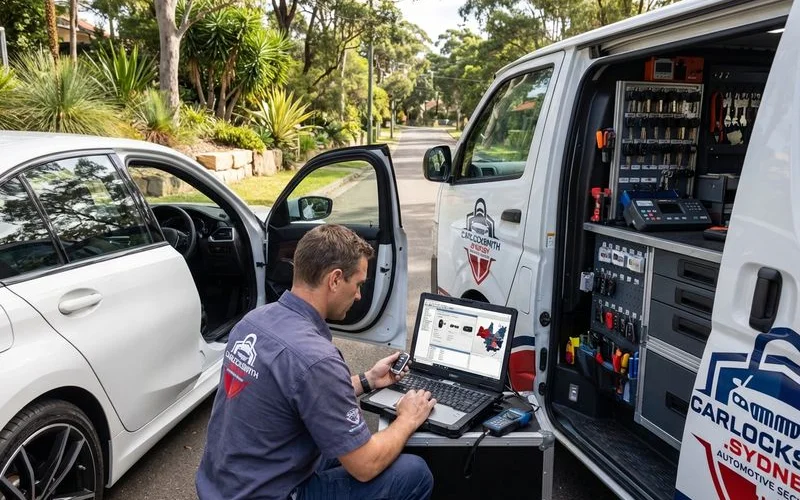
- Verify Mobile Capability: A true specialist brings the lab to you. They should be able to cut the emergency blade and program the chip in their van.
Key Takeaways for BMW and Mercedes Owners
Taking action before a total failure is the best way to save money.
- Get a spare immediately. A spare car key replacement costs roughly 50% less than an “all keys lost” recovery service.
- Watch for the “ELV” warning. On BMWs, a yellow steering wheel icon on the dash means your steering lock is dying. Fix it now before it strands you.
- Keep keys away from magnets. Placing your key near a strong magnet (like a purse clasp or phone mount) can sometimes corrupt the transponder data.
- Save your VIN and Rego. Keep a photo of your registration papers on your phone. We need proof of ownership before we can legally cut a key.
- Don’t ignore the warning signs. If you have to press the button twice or wiggle the key to start the car, the system is failing. It will not fix itself. For a broader look at the cost factors for all European brands, read our guide on why European car keys cost more.
Looking for this service?
View our european car locksmith service →