
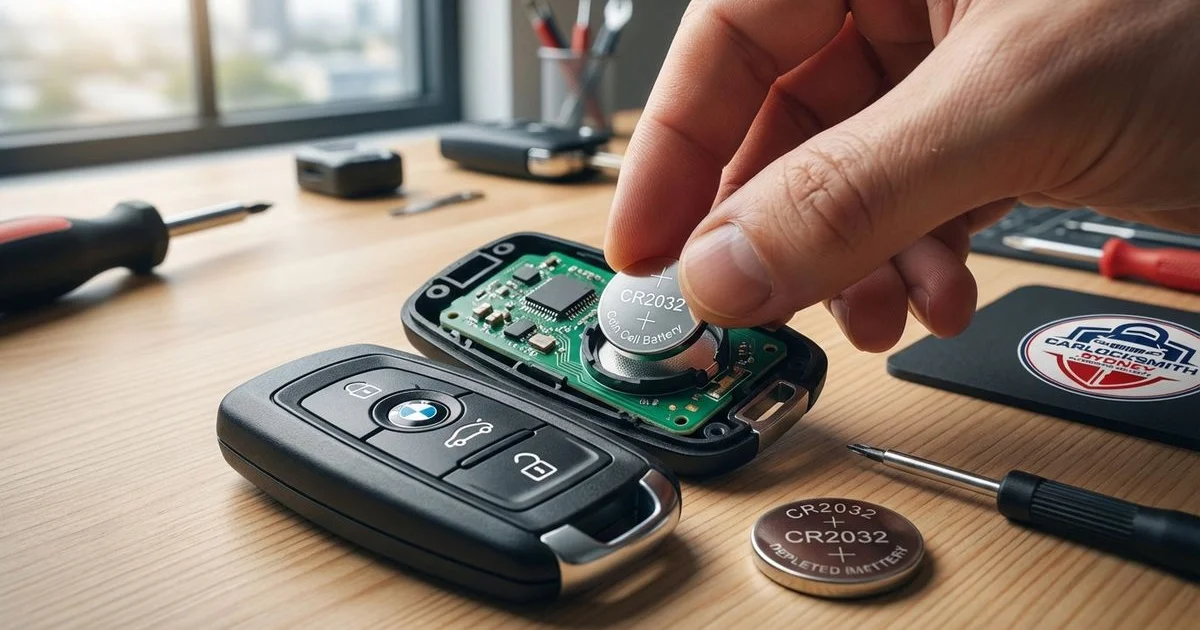
How to Replace Your Car Key Battery
A dead key fob usually happens at the worst possible time.
We see it constantly—a driver loaded with groceries at Woolworths or running late for a meeting in the CBD, pressing a button that refuses to work.
That panic is understandable, but the solution is actually quite simple.
From our experience on the road, 90% of “broken” keys just need a fresh power source.
This fix typically costs less than $12 at a local shop and takes about three minutes to complete.
We have compiled this guide to walk you through the process for the most common keys found in Australia.
You will learn exactly which battery you need and how to install it without snapping the plastic casing.
How to Tell Your Key Battery Is Dying
Most modern fobs will give you a few weeks of warning before they fail completely.
Your car usually communicates these issues through subtle performance drops.
- Reduced signal range: You used to unlock the car from the kitchen window, but now you must stand right next to the driver’s door.
- The LED indicator check: Most fobs have a small red light that flashes when pressed; if this light is dim or does not flash, the voltage is critically low.
- Inconsistent operation: The doors unlock on the second or third press rather than the first.
- Dashboard alerts: Vehicles like the VW Golf, Ford Ranger, and Toyota RAV4 often display a “Key Battery Low” message on the instrument cluster.
- Push-button lag: The car takes a second or two to recognize the key is inside the cabin before the engine starts.
Taking action when these signs appear prevents a total lockout.
A completely dead battery might trigger the car’s anti-theft immobiliser if the system loses the signal entirely during a start attempt.
Identifying Your Battery Type
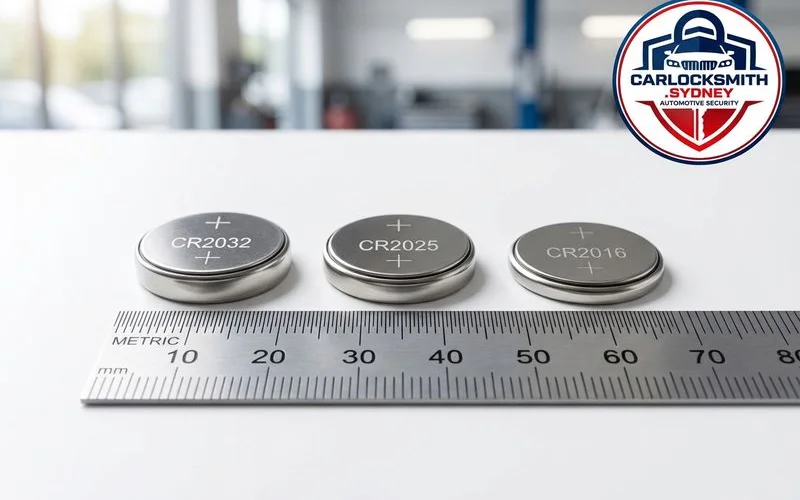
Car manufacturers generally stick to a few standard lithium coin cell sizes.
We always recommend verifying the code printed on the back of your current battery, as years and models vary.
| Battery Type | Dimensions | Voltage | Typical Models (Australia) |
|---|---|---|---|
| CR2032 | 20mm x 3.2mm | 3V | Holden Commodore, Toyota Corolla, Hyundai i30, Most BMWs |
| CR2025 | 20mm x 2.5mm | 3V | Mazda 3/CX-5, Newer Mercedes, Nissan X-Trail |
| CR2016 | 20mm x 1.6mm | 3V | Older Toyota, Mitsubishi keys with rubber buttons |
| CR1632 | 16mm x 3.2mm | 3V | Smart keys for Suzuki Swift, older Toyota Prius |
| CR2450 | 24mm x 5.0mm | 3V | Newer BMW F-Series, Mini Cooper (Thicker battery) |
The CR2032 is the industry standard, powering roughly 70% of the keys we service.
Important Shopping Tip: Be careful with batteries labeled “Bitrex” or “Bitter Coating” (often found on Duracell). Manufacturers apply this coating to prevent children from swallowing the batteries. This safety layer can sometimes interfere with the electrical contacts in sensitive car keys, preventing them from working even when new. Panasonic or Energizer batteries often provide a more reliable connection for automotive fobs.
Where to buy: You can find these at Coles, Woolworths, Bunnings Warehouse, or Jaycar Electronics. Expect to pay between $6 and $12 for a twin pack depending on the retailer.
Step-by-Step Battery Replacement by Key Type
Standard Remote Fob (Separate From Key)
This setup involves a standalone plastic remote on the same ring as a traditional metal ignition key. It is standard on older models like the Holden Commodore (VY-VE), Ford Falcon, and early Hyundai Getz.
Steps:
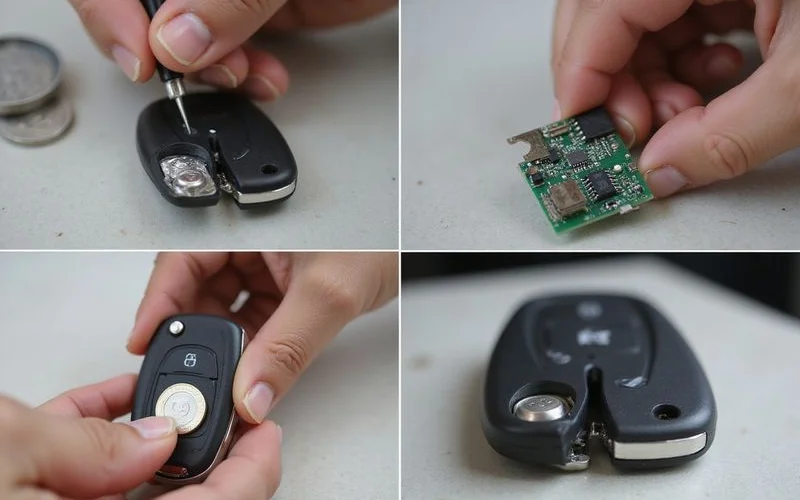
- Look for a small notch on the seam or a screw on the back of the casing.
- Remove the screw using a precision Phillips screwdriver (usually size #0 or #00) if one is present.
- Insert a flathead screwdriver or a coin into the notch and twist gently to pop the halves apart.
- Lift the old battery out, noting that the positive (+) side usually faces the back cover.
- Wait 10 seconds before inserting the new battery to allow the capacitor to discharge.
- Place the new battery in firmly and snap the case back together.
- Test the lock button immediately.
Flip Key (Folding Blade)
These “switchblade” style keys are popular with Volkswagen, Audi, Kia, and the Ford Ranger. The spring mechanism adds a layer of complexity, so keep a firm grip on the casing.
Steps:
- Flip the metal key blade out to the extended position.
- Locate the separation point, which is often inside the channel where the key usually sits.
- Wedge a removal tool or coin into the gap and twist to separate the battery cover from the main body.
- Pro Tip: Some VW keys require you to pull the battery cover upward rather than prying it apart.
- Swap the battery, ensuring the new one sits flat against the contacts.
- Align the cover carefully; the plastic clips on flip keys are prone to snapping if forced.
- Press down until you hear a solid click.
Toyota Smart Key
Toyota uses a very specific design for models like the Camry, RAV4, and Kluger. This design is clever because it uses the key’s own emergency blade as the opening tool.
Steps:
- Push the small release button on the side to slide out the hidden metal emergency key.
- Look for a slot on the corner of the fob case that matches the tip of that metal key.
- Insert the metal key tip into that slot and twist it like you are turning a lock.
- The case will pop open revealing the green circuit board and the battery.
- Caution: Lift the battery gently; do not tip the fob upside down or the buttons may fall out.
- Install the new CR2032 battery with the positive (+) side facing up.
- Snap the case together and slide the emergency key back in.
BMW Smart Key (Comfort Access)
BMW keys vary significantly between the older E-Series and the newer F/G-Series. Older diamond-shaped keys often have rechargeable batteries soldered to the board that charge in the ignition, meaning they cannot be swapped easily. The following steps apply to the newer rectangular “Comfort Access” fobs.
Steps for F-Series and G-Series:
- Press the side button to release the internal metal key blade.
- Locate the small back panel cover—it does not require splitting the whole key in half.
- Use the metal key blade to pry up the small cover plate.
- Remove the old battery and insert the new one.
- Critical Detail: BMW remotes often use the CR2450 (thicker) or CR2032; check before forcing the cover shut.
- Clip the cover back on and reinsert the blade.
Mercedes Smart Key
Mercedes-Benz fobs are engineered with tight tolerances. These keys (Chrome Key versions) almost always use a CR2025 battery, which is thinner than the standard CR2032.
Steps:
- Slide the small catch at the top of the fob to release the emergency key.
- Pull the key blade out completely.
- Look inside the empty slot where the key was; there is a small black tab or push-button inside.
- Push that internal tab with the tip of the key blade while pulling the back cover of the fob upwards.
- The entire back panel will slide off.
- Replace the CR2025 battery.
- Slide the cover back until it locks and reinsert the metal key.
Tips to Avoid Damaging Your Key Fob
A DIY replacement is safe, but the internal components are fragile. We often repair keys where a screwdriver has slipped and gouged the electronics.
Use the Right Tools (Not a Kitchen Knife)
Prying a key open with a sharp knife is a recipe for personal injury and scratched plastic. We suggest using a dedicated plastic pry tool (spudger) or a flat coin like a 20-cent piece. The softer metal of a coin is less likely to dig into the plastic casing than a steel screwdriver.
Respect the Waterproof Seal
Many modern keys, especially for utes like the Hilux or Triton, have a rubber O-ring inside to keep moisture out. It is easy to pinch this rubber seal when snapping the case back together. Check that the rubber ring is seated in its groove before closing the case to maintain water resistance.
The 3-Minute Rule
Some older vehicle computers may “forget” the key pairing if the battery is removed for too long. We recommend having the new battery unpackaged and ready to go before you remove the old one. Try to complete the swap within three minutes to ensure the on-board memory capacitor stays charged.
Handle the Circuit Board with Care
The green chip inside your key is sensitive to static electricity and skin oils. Hold the internal module by the plastic edges only. If the buttons fall out of the rubber membrane, place them back into the front cover face-down before reassembling.
What to Do If the Remote Does Not Work After Battery Replacement
A fresh battery does not always guarantee an instant fix. The car’s computer might need a moment to recognize the new signal strength.
The “Lock Cycle” Reset
We advise inserting the physical metal key into the driver’s door lock. Turn it to the lock position, then unlock, then lock again physically. This mechanical action often wakes up the central locking module and forces it to poll for the remote signal.
Resynchronisation Steps
Certain manufacturers like Volkswagen and Nissan require a specific sync sequence.
- Press and hold the “Unlock” button on the fob.
- While holding the button, insert the key into the ignition and turn it to “Accessories” (do not start the engine).
- Hold for 10 seconds, then turn off and remove the key.
- Test the buttons.
Check the Prongs
Sometimes the metal contacts inside the battery compartment get pushed down over time. If the new battery is loose, gently pry the metal contact prongs upward slightly with a small screwdriver to create a tighter fit.
How Long Do Key Fob Batteries Last?
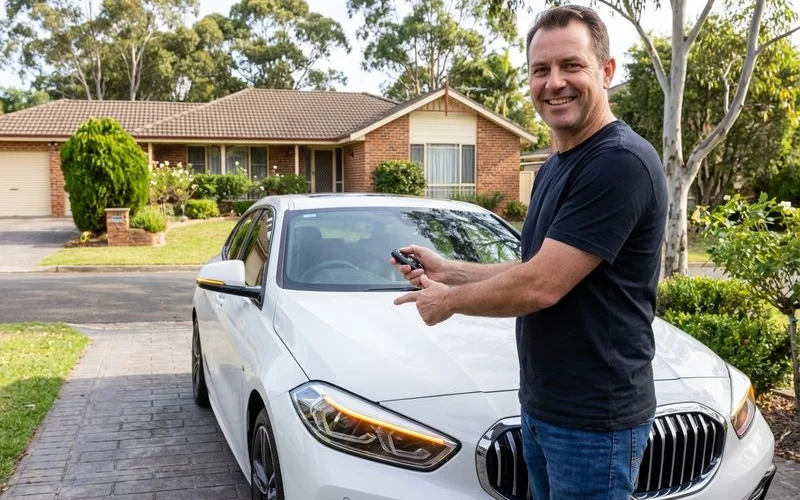
You can generally expect a quality lithium battery to last between two and four years. However, “Smart Keys” (Keyless Go) that allow you to start the car while the key is in your pocket drain much faster than standard remote keys.
Several environmental factors also shorten this lifespan:
- Key Proximity: Storing your keys on a hook near the garage or your parked car keeps the fob in constant communication with the vehicle, draining power 24/7.
- The “Sleep Mode” Feature: New fobs (like those from Mazda and Toyota) have a battery-saving mode; typically, holding the lock button while pressing unlock twice puts the key to sleep.
- Cold Weather: Lithium batteries lose voltage efficiency in temperatures below 10°C, leading to temporary failure on cold mornings.
Pro Tip: The Annual Swap
We suggest changing your key battery every time you renew your rego. It is a simple calendar trigger that ensures you are never stranded with a dead remote. For the cost of a cup of coffee, it is cheap insurance against a lockout. If you want to understand the broader differences between key technologies, read our smart key vs transponder key comparison.
When a Battery Replacement Is Not Enough
If a new name-brand battery and a sync attempt fail, the issue likely lies with the hardware.
- Micro-switch failure: The tiny buttons soldered to the board can detach or wear out, meaning the click you feel isn’t completing the circuit.
- Water corrosion: Even a small amount of moisture from months ago can grow white/green corrosion on the chip, slowly eating the copper traces.
- Shell damage: If the plastic case is cracked, the battery may not be sitting tight enough against the contacts.
In these instances, you will need more than a battery. A professional locksmith can often repair the circuit board or transfer your transponder chip into a new shell through a key shell replacement, saving you the cost of a full dealership replacement.
Looking for this service?
View our key shell replacement service →