
Smart Key vs Transponder Key: Understanding the Difference
You are likely standing in a parking lot right now wondering why your car won’t start or staring at a quote for a replacement key that seems incredibly high. We see this situation daily across Sydney. Drivers often don’t realize how complex their car keys have become until something goes wrong.
The days of a simple $10 metal key cut at a hardware store are long gone. Modern vehicles use sophisticated security systems that require precise digital authentication. This technology keeps your car safe, but it also changes how you handle a lockout or a lost key situation.
We put together this guide to clarify exactly what you are holding in your hand. Knowing the difference between a transponder key and a smart key will help you understand your repair options and avoid overpaying for a smart key replacement.
The Basic Difference
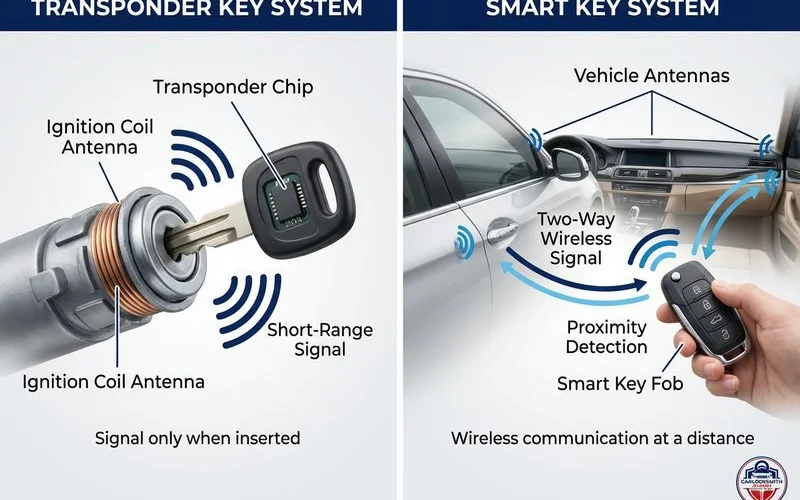
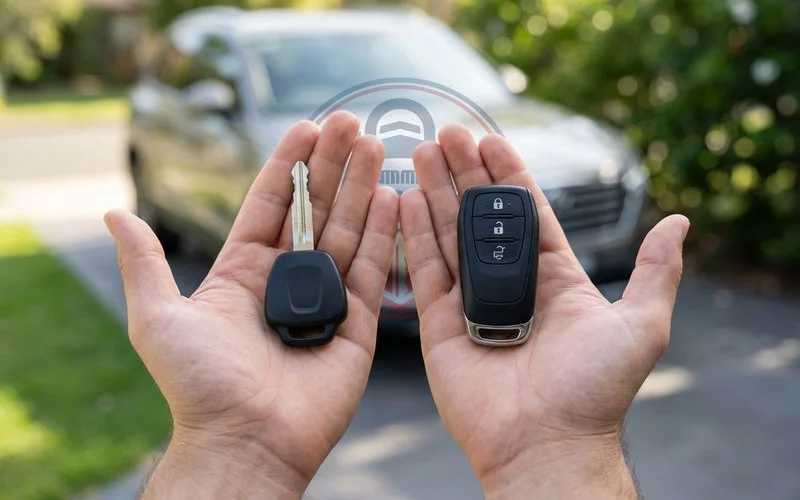
A transponder key functions as a standard physical key with a hidden security layer. You must insert the metal blade into the ignition and turn it. A tiny microchip inside the plastic head sends a signal to your car’s computer to allow the engine to start.
A smart key (often called a proximity fob or intelligent key) removes the mechanical step entirely. This device stays in your pocket or bag. The vehicle detects the signal wirelessly, allowing you to unlock the doors by pulling the handle and start the engine by pressing a dashboard button.
How Each System Works
Transponder Key Operation
The technology inside a transponder key is reliable and has been the industry standard since the mid-1990s.
- Insertion: You place the key blade into the ignition cylinder.
- Induction: An antenna coil around the ignition lock sends a burst of energy to the key.
- Authentication: The chip inside the key head (usually a glass or carbon ampoule) uses that energy to send a unique alphanumeric code back to the car’s immobiliser system.
- Verification: If the code matches the vehicle’s memory, the Engine Control Unit (ECU) allows the fuel injection system to fire.
We find that many drivers mistake a transponder key for a standard metal key because the chip is completely hidden inside the plastic head.
Smart Key Operation
Smart keys utilize a more complex, active communication system that requires constant power.
- Wake-Up Signal: As you walk within 1 to 2 metres of your car, antennas in the bodywork broadcast a low-frequency (LF) search signal.
- Active Response: Your fob receives this request and uses its battery to transmit an encrypted Ultra High Frequency (UHF) code back to the car (typically 315MHz or 433MHz).
- Access Granted: The central computer verifies the digital handshake and unlocks the door when you touch the sensor.
- Zone Detection: Once inside, internal cabin antennas confirm the key is physically inside the vehicle—not just near it—before enabling the push-to-start button.
Feature Comparison
Understanding the technical limitations and features of your specific key type helps you manage expectations regarding battery life and repair costs.
| Feature | Transponder Key | Smart Key |
|---|---|---|
| Primary Interaction | Insert and turn | Touch and push |
| Power Source | Passive (powered by ignition coil) | Active (requires internal battery) |
| Battery Life | N/A (Remote buttons may need battery) | 1-2 years (Critical for operation) |
| Typical Range | Contact only (Ignition barrel) | 80cm - 1.5 metres |
| Keyless Entry | Requires pressing remote buttons | Passive (touch handle) |
| Security Standard | Fixed or Rolling Code (ID46/4D) | 128-bit AES Encryption |
| Emergency Start | Mechanical turning | Holding dead fob to start button |
| Avg. Market Cost (AU) | $160 - $450 | $380 - $950+ |
How to Tell Which Key You Have
Identifying your key type is the first step in getting an accurate quote for a spare or replacement.
You Have a Transponder Key If:
- There is a mechanical action: You must physically turn a cylinder to crank the engine.
- The key head is bulky: The plastic top is thicker than a standard house key to accommodate the embedded chip.
- The blade is exposed: You can see the metal part of the key at all times.
- Security light behavior: When you insert the key, a flashing security light on your dashboard (often a padlock or car icon) turns solid or shuts off immediately.
You Have a Smart Key If:
- No ignition cylinder exists: The steering column is smooth, with no slot for a key.
- Push-button start: You start the car by pressing a button labeled “Start/Stop” while holding the brake.
- Hidden blades: The metal key blade is concealed inside the fob body and is only used for emergency door unlocking.
- Proximity unlocking: You can open the car door while the key remains in your pocket.
You Have a Combination System If:
Some manufacturers, particularly Toyota and Honda during the 2005-2015 transition era, created hybrids. You might have a “remote head key” where the lock/unlock buttons are built into the key head, but you still have to insert it into the ignition. While these look like smart keys, they function technically as transponder keys because they require physical insertion to start the engine.
Security Differences
Transponder Key Security
Transponder systems are excellent at preventing “hot-wiring.” Since the car demands a digital code, thieves cannot simply force the ignition lock to start the car.
We advise customers that the main weakness here is physical theft of the key itself. However, because the chip requires close proximity to the ignition coil (less than 2cm), these keys are immune to long-range signal interception.
Smart Key Security
Smart keys offer convenience but introduce a high-tech risk known as a “Relay Attack.” Thieves can use signal boosters to bridge the gap between your key (sitting on your kitchen bench) and your car (parked in the driveway), tricking the vehicle into unlocking.
Actionable Protection Tips:
- The Faraday Pouch: Store your smart keys in a signal-blocking bag (available for under $20) when at home. This is the single most effective defense.
- The “Sleep” Mode: Newer fobs (like those for recent Mercedes or Toyota models) have motion sensors that turn the battery off after 5 minutes of inactivity. Check your owner’s manual to see if you can enable this.
- Distance Matters: Do not leave your keys on a hallway table immediately inside your front door. Move them at least 5 metres away from the vehicle’s perimeter.
Battery Considerations
Transponder Keys
A pure transponder key is a “forever” device. The chip inside does not require a battery to start the engine.
If your transponder key has remote buttons for the doors, that battery is solely for the locks. Even if that battery dies completely, you can still unlock the door manually with the blade and the car will start immediately. You will never be stranded by a dead battery with this system.
Smart Keys
Smart keys are different because they are constantly “listening” for your car’s signal. This drains the battery, typically a CR2032 or CR2450 coin cell, within 18 to 36 months.
We receive panic calls frequently about this, but you can usually self-rescue. Every smart key system has a fail-safe:
- The Mechanical Blade: Slide the latch on your fob to release the hidden metal key. Use this to unlock the driver’s door manually.
- The Passive Start: Hold the back of your dead fob directly against the “Start” button (or the marked spot on the steering column) for 5 seconds. The car will energize the chip inductively—just like a transponder key—and allow you to start the engine.
Cost Differences and Why
The price gap between these two technologies shocks many car owners. A smart key can cost double or triple what a transponder key costs.
Parts Cost
The hardware inside a smart key is a miniaturized computer. It contains a UHF transmitter, LF receiver, cryptographic processor, and backup transponder. An OEM (Original Equipment Manufacturer) smart fob for a modern Mazda or Volkswagen can cost $300 to $600 just for the unprogrammed hardware.
Programming Complexity
Transponder programming is straightforward. We plug into the OBD (On-Board Diagnostics) port and introduce the new key ID to the car’s list of approved keys.
Smart key programming involves synchronizing multiple modules. We must pair the key with the Body Control Module (BCM), the Keyless Access Module, and the Engine Control Unit. This often requires purchasing a secure “pin code” or digital signature from the manufacturer’s database, which adds to the service cost.
Equipment Investment
The diagnostic tablets required to program 2024-2026 model smart keys are significant investments. We pay annual software subscriptions to maintain access to brands like Audi, BMW, and Toyota.
Replacement Cost Summary (Sydney Market Estimates)
| Key Type | Spare Key Cost | All Keys Lost Cost |
|---|---|---|
| Standard Transponder (e.g., Ford, Toyota) | $160 - $280 | $350 - $550 |
| High-Security Transponder (e.g., VW, Honda) | $250 - $450 | $550 - $850 |
| Smart Key (Japanese/Korean) | $380 - $650 | $650 - $1,100 |
| Smart Key (European/Luxury) | $600 - $1,200 | $1,200 - $2,500+ |
Which Is Better?
Most drivers don’t get to choose their key type as it is determined by the trim level of the vehicle. However, knowing the pros and cons helps you prepare.
The Case for Transponder Keys:
- Reliability: Fewer electronic components mean less chance of failure.
- Water Resistance: Many sealed transponder keys can survive a swim at Bondi Beach better than a circuit-heavy smart fob.
- Cost: Spares are affordable enough that you should always have two.
The Case for Smart Keys:
- Safety: You don’t have to fumble for keys in a dark car park; you just get in and go.
- Integration: These keys link to driver profiles, automatically adjusting seat positions, mirrors, and climate control when you unlock the car.
- Security: Advanced encryption (like 128-bit AES) makes digital cloning much harder for thieves compared to older 40-bit transponder signals.
The Bottom Line
Both transponder keys and smart keys provide strong security, but they require different levels of care. If you have a smart key, keep an eye on that dashboard battery warning and change the cell immediately when it appears. If you have a transponder key, appreciate the durability and lower cost of ownership.
We cannot stress this enough: regardless of your key type, operating a vehicle with only one key is a financial risk. Losing your last key changes a standard duplication job into a complex “all keys lost” recovery that can cost significantly more. If you are down to your last key, contact a professional to arrange a spare car key replacement before an emergency strikes. For a deeper look at all the key types used in cars today, see our guide on types of car keys explained.
Looking for this service?
View our smart key replacement service →