
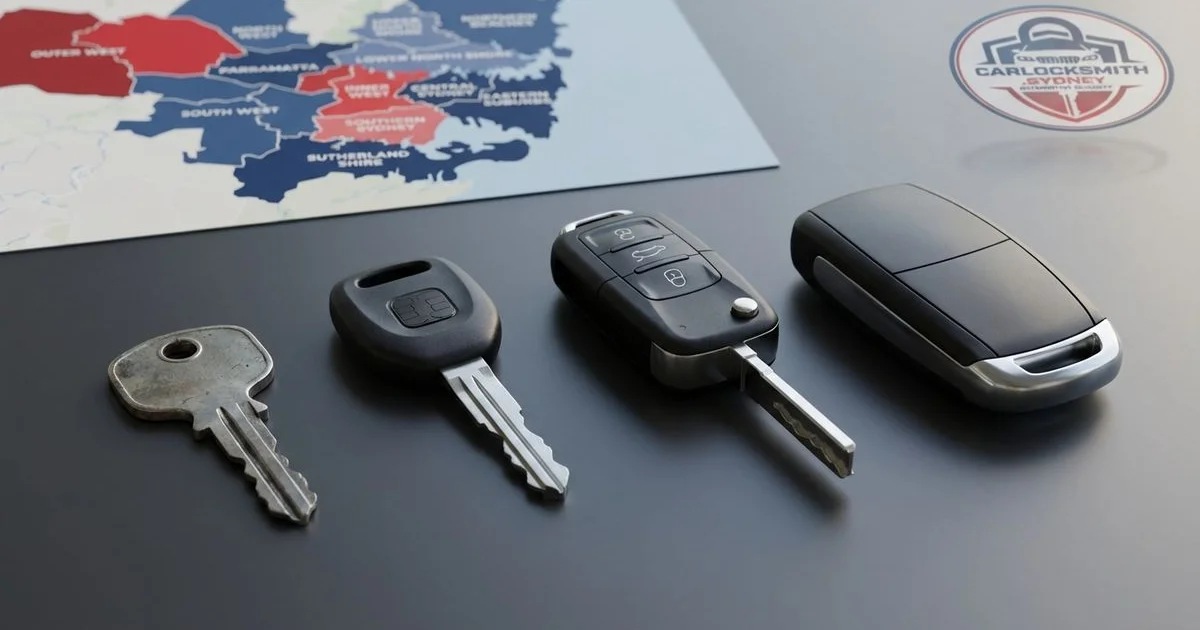
Car keys have evolved dramatically over the past three decades. What used to be a simple metal blade that turned a lock has become a sophisticated electronic device packed with security features. If you have ever wondered what type of key your car uses, or why your neighbour’s Toyota key looks nothing like yours, this guide breaks it all down.
Understanding your key type matters because it directly affects how much a car key replacement costs, how long it takes, and who can do the work. Here are the four main types of car keys used in vehicles on Sydney roads today.
Type 1: Mechanical Keys (Traditional Metal Keys)
What They Are
Mechanical keys are the original car key design. They feature a metal blade with a unique cut pattern that physically turns the lock cylinder and ignition switch. There is no electronic component, no chip, and no battery.
How They Work
The key’s cut pattern matches the pin tumblers inside the lock. When the correct key is inserted, the pins align and the cylinder turns, unlocking the door or starting the engine. It is a purely mechanical process.
Which Cars Use Them
Mechanical keys were standard on virtually all vehicles until the mid-1990s. You will still find them on:
- Most cars manufactured before 1995
- Some budget vehicles from the late 1990s and early 2000s
- Classic cars and vintage vehicles
- Certain commercial vehicles and fleet cars
Pros and Cons
Pros:
- Very cheap to replace ($50 to $120)
- Any locksmith can cut one quickly
- No programming required
- No battery to go flat
Cons:
- No immobiliser protection, making the car easier to steal
- Keys can be easily duplicated at any key-cutting kiosk
- Locks are vulnerable to picking and bumping
- No remote locking or unlocking
Insider Insight: The “Worn Key” Effect
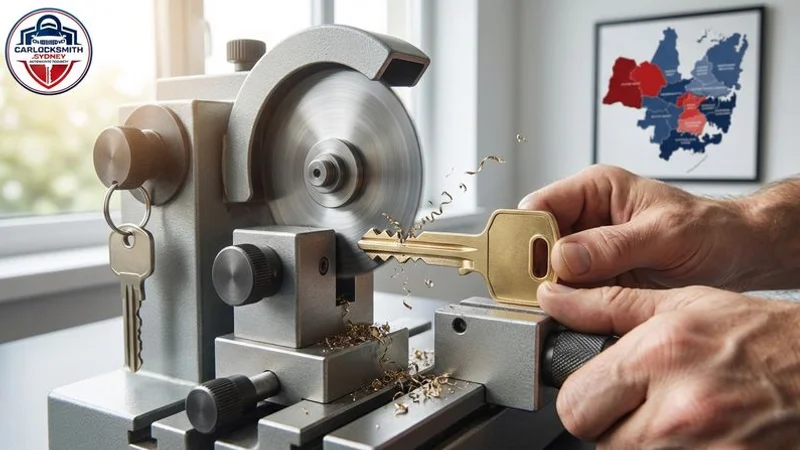
We often see older Holden Commodores (VN-VS) or Ford Falcons where the original key has worn down so much it stops working. Copies made from these worn keys will also fail. A professional locksmith can “decode” the lock to cut a fresh factory-original blade, rather than just duplicating the problem.
Type 2: Transponder Keys
What They Are
Transponder keys look like mechanical keys but contain a small electronic chip embedded in the plastic head. The word “transponder” is a combination of “transmitter” and “responder,” which describes exactly what the chip does.
How They Work
When you insert the key and turn the ignition, the car’s antenna ring (located around the ignition barrel) sends a radio signal to the chip. The chip responds with a unique encrypted code. If the car’s immobiliser recognises the code, the engine starts. If it does not recognise the code, or if there is no chip at all, the immobiliser prevents the engine from firing.
This means that even if someone copies the physical blade perfectly, the car will not start without the correct chip.
Which Cars Use Them
Transponder keys became widespread from the late 1990s and are still used on many vehicles today:
- Toyota: Most models from 1998 onwards (including Camry, Corolla, HiLux)
- Ford: Most models from 1999 onwards
- Holden: Most models from 1999 onwards
- Mazda: Most models from 2000 onwards
- Hyundai / Kia: Most models from 2005 onwards
- Subaru: Most models from 2000 onwards
Pros and Cons
Pros:
- Immobiliser prevents the car from being hot-wired
- Significantly reduces theft risk (cars with immobilisers are 40% less likely to be stolen)
- Physical key still works if the battery or electronics fail
- Moderate replacement cost ($150 to $350)
Cons:
- Requires programming, which needs specialised equipment
- More expensive than mechanical keys
- Cannot be duplicated at a hardware store kiosk
- If the chip fails, the car will not start even with the correct blade
Critical Warning: The eBay Trap
Many drivers try to save money by buying cheap “uncut” transponder keys online. We frequently have to tell customers that these keys often come with the wrong chip type (like an ID46 instead of a 4D67) or are “locked” to a different VIN. This makes them impossible to program. It is safer to get the chip supplied and coded by a professional who guarantees the part.
Type 3: Remote Keys (Key Fob + Blade)
What They Are
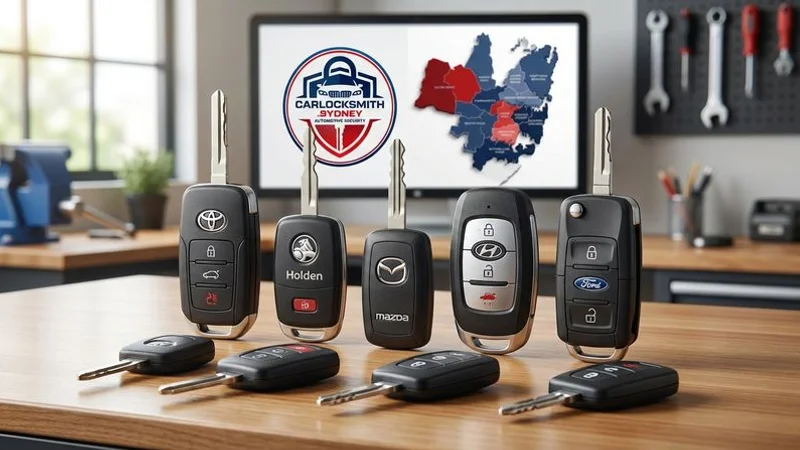
Remote keys combine a transponder key with a wireless remote control. The remote, often called a “fob,” has buttons for locking, unlocking, and sometimes opening the boot or triggering the alarm. The key blade and remote may be integrated into a single unit (flip key) or be separate pieces.
How They Work
The remote communicates with the car via a short-range radio frequency signal. When you press the lock or unlock button, it sends an encrypted rolling code to the car’s receiver, which triggers the central locking system. The transponder chip still handles engine immobilisation separately.
Which Cars Use Them
Remote keys are extremely common and are found on most vehicles manufactured between 2005 and 2018:
- Toyota (Corolla, RAV4, Camry from 2005-2018)
- Mazda (Mazda3, CX-5 from 2006-2018)
- Volkswagen (Golf, Polo, Tiguan — many use flip key remotes)
- Ford (Focus, Ranger, Territory)
- Honda (Civic, CR-V, Accord)
- Nissan (X-Trail, Pathfinder, Navara)
Pros and Cons
Pros:
- Convenient keyless entry from a distance
- Immobiliser protection via transponder chip
- Some models include panic button for safety
- Boot release button is handy for grocery runs
Cons:
- Remote batteries need replacing every 1 to 3 years
- More expensive to replace than transponder-only keys ($200 to $450)
- The remote module can fail independently of the key blade
- Water damage can kill the electronics
Common Sydney Failures
We see a specific issue with Holden VE and VF Commodore flip keys where the metal blade snaps right off the plastic housing. This leaves you with a remote that works but a key you can’t turn. Instead of taping it back together, we can often perform a key shell replacement into a sturdier aftermarket casing for a fraction of the cost of a new key.
Type 4: Smart Keys (Proximity Keys)
What They Are
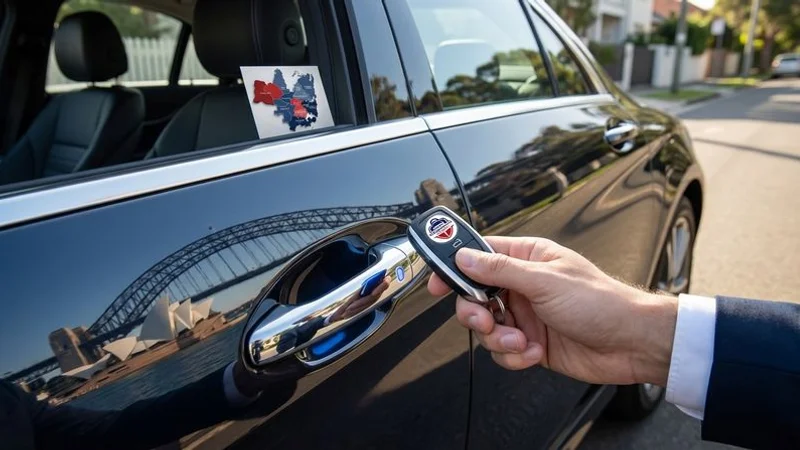
Smart keys represent the latest generation of car key technology. They are fully electronic, meaning you never insert them into a lock or ignition. The car detects the key’s presence through proximity sensors, allowing you to unlock the doors by touching the handle and start the engine with a push button.
How They Work
Smart keys use a combination of low-frequency (LF) and radio-frequency (RF) signals. When you approach the car with the smart key in your pocket or bag:
- The car’s external sensors detect the key and unlock the doors when you touch or pull the door handle
- Inside the car, cabin sensors confirm the key is present
- You press the start/stop button to fire up the engine
- When you leave the car and walk away, the car automatically locks (on most models)
The communication between the key and car is heavily encrypted to prevent relay attacks and cloning.
Which Cars Use Them
Smart keys are now standard or optional on most new vehicles sold in Australia:
- Toyota (most models from 2018+, including RAV4, Camry, Corolla)
- Mazda (CX-5, CX-30, Mazda3 from 2019+)
- Hyundai (i30, Tucson, Santa Fe from 2018+)
- Kia (Cerato, Sportage, Sorento from 2018+)
- BMW (all models from 2015+)
- Mercedes-Benz (all models from 2016+)
- Tesla (all models — uses phone as primary key, card as backup)
Pros and Cons
Pros:
- Ultimate convenience, as you never remove the key from your pocket
- Advanced encryption provides superior theft protection
- Many include features like remote start, car finder, and climate pre-conditioning
- Walk-away auto-lock prevents forgetting to lock the car
Cons:
- The most expensive key type to replace ($300 to $800+)
- Vulnerable to relay attacks if not properly secured
- Battery replacement requires opening the sealed fob
- If the battery dies, you need to use a hidden mechanical blade or hold the fob against a specific point on the car to start it
Pro-Tip: The “Sleep Mode” Defence
Newer Toyota and Mazda smart keys have a hidden battery-saving function that also blocks relay theft. To activate it on a Toyota fob, hold down the Lock button and simultaneously press Unlock twice. The LED will flash four times to confirm. This stops the key from transmitting signals until you press a button again, making it invisible to thieves with scanners.
How to Identify Your Key Type
If you are not sure which type of key you have, here is a quick identification guide:
| Feature | Mechanical | Transponder | Remote | Smart |
|---|---|---|---|---|
| Metal blade | Yes | Yes | Yes (or flip) | Usually hidden |
| Plastic head | Small/none | Thick plastic | Thick with buttons | Large fob |
| Buttons on key | No | No | Yes (2-4) | Yes (2-4) |
| Start method | Turn in ignition | Turn in ignition | Turn in ignition | Push button |
| Lock method | Turn in door | Turn in door | Press button | Touch handle |
Still unsure? A professional car locksmith can identify your key type in seconds based on your car’s make, model, and year.
Why Your Key Type Matters
Understanding your key type is important for three practical reasons:
- Replacement cost — mechanical keys cost under $100, while smart keys can exceed $800
- Who can replace it — mechanical keys can be cut anywhere, but smart keys require specialised equipment
- Emergency backup — knowing whether your smart key has a hidden mechanical blade can save you when the battery dies
The Bottom Line
Car keys have come a long way from simple metal blades. Whether you drive an older vehicle with a mechanical key or a new model with a smart proximity key, knowing what you have helps you plan for replacements, understand costs, and avoid being caught off guard.
If you need a replacement key for any type — mechanical, transponder, remote, or smart — a licensed Sydney car locksmith can handle it on-site, usually within an hour. For a deeper look at the differences between the two most advanced types, see our smart key vs transponder key comparison. No appointment needed, no towing required, and at a fraction of the dealership price.
Looking for this service?
View our car key replacement service →