
What Is a Transponder Key?
You turn the key in the ignition. The dashboard lights up as usual. But the engine remains dead silent.
This is the exact moment many of our customers realize something is wrong with their security system rather than their battery.
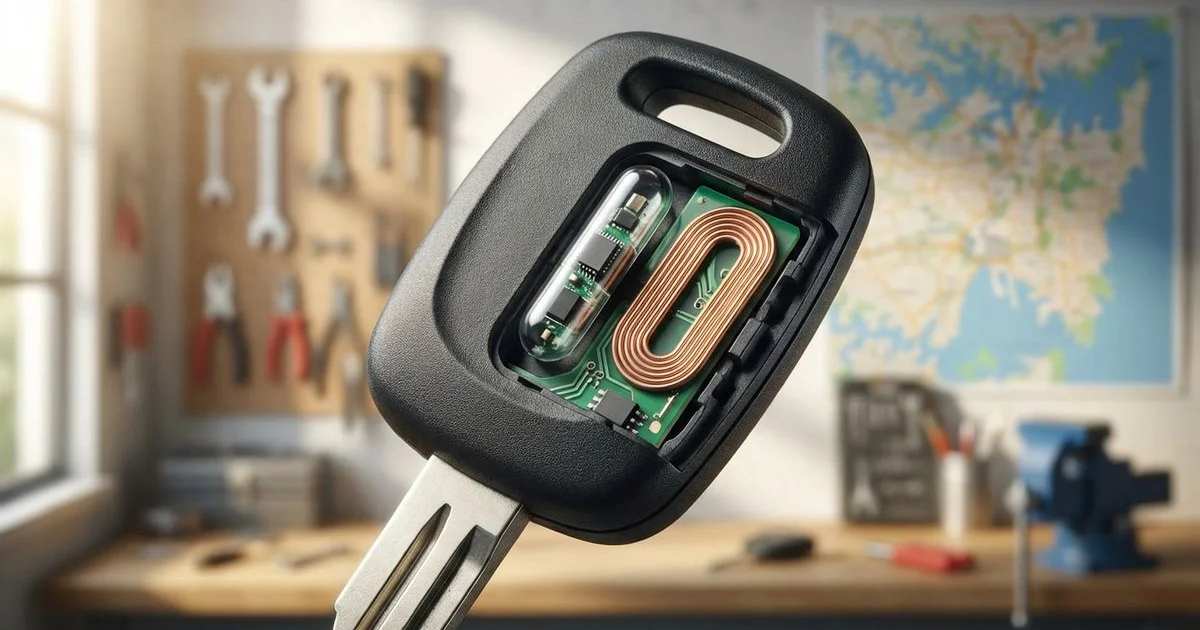
We see this scenario play out on Sydney roads every single day. The culprit is almost always a tiny, invisible component hidden inside the plastic head of your key.
It is called a transponder chip.
If your vehicle was manufactured for the Australian market after the mid-1990s, you almost certainly have one.
We want to explain exactly what this technology is.
This guide covers how these keys work, why they fail, and the specific steps required for transponder key programming to get you back on the road.
How a Transponder Key Works
The term “transponder” blends “transmitter” and “responder.”
This name perfectly describes the component’s job.
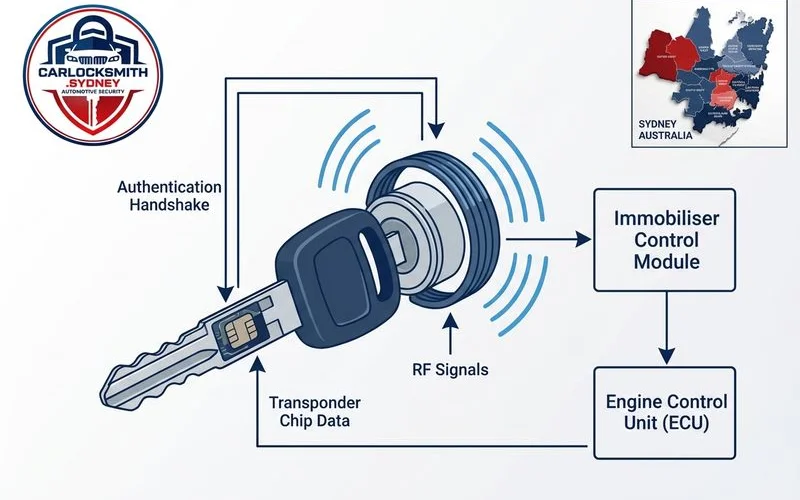
We rely on this technology because it creates a virtual handshake between your key and your car’s computer.
The Virtual Handshake Process
The process happens in milliseconds.
Here is what actually occurs when you turn that key:
- Induction: You insert the key. The car’s “antenna ring” (a coil around the ignition lock) sends out a burst of electromagnetic energy.
- Power Up: This energy powers the tiny chip inside your key head. The chip does not need its own battery because it runs off this energy field.
- The Challenge: The car’s immobiliser system sends a complex “challenge” code to the key.
- The Response: The chip solves the mathematical challenge using a unique digital signature and transmits the answer back.
- Ignition: If the car recognizes the answer, the engine fires. If the math doesn’t match, the fuel pump stays off.
This is why a simple metal copy cut at a hardware store will open your doors but will never start the engine.
The mechanical cuts align the lock tumblers, but the digital password is missing.
A Brief History of Transponder Keys in Australia
Security standards have changed drastically over the last three decades.
We have seen the technology evolve from simple fixed numbers to military-grade encryption.
The Early Mandates (1990s - 2001)
Manufacturers began adding chips voluntarily in the mid-90s to combat rising car theft.
However, the real game-changer in Australia was the introduction of Australian Design Rule (ADR) 82/00.
This regulation effectively mandated engine immobilisers for all new passenger cars sold from July 2001.
If you drive a Holden Commodore VT or a Ford Falcon AU from this era, you are using this first-generation tech.
Rolling Codes (The 2000s Shift)
Thieves eventually figured out how to clone the static codes used in early keys.
Manufacturers responded with “rolling code” technology.
We describe this to customers as a password that changes every single time you use it.
The car and the key verify each other, and then they agree on a new password for the next time you start the engine.
Modern Encryption (2010s - Present)
Today’s vehicles use advanced cryptographic chips.
Brands like Volkswagen and Audi now use systems like the Megamos Crypto, while Toyota utilizes 128-bit encryption similar to what protects online banking.
These systems are incredibly secure but require specialized diagnostic equipment to program.
Types of Transponder Chips
Not all chips are created equal.
We carry dozens of different chip types in our service vans to cover the variety of vehicles in Sydney.
Knowing which type your car uses can explain why some replacement keys cost more than others.
Common Chips Used in Australian Vehicles
| Chip Manufacturer | Chip ID / Type | Common Vehicle Brands | Security Style |
|---|---|---|---|
| Texas Instruments | 4C | Older Toyota, Ford, Holden | Fixed Code (Older) |
| Texas Instruments | 4D / 4D-60 | Ford, Subaru, Nissan | Crypto / Rolling |
| Philips / NXP | ID46 (PCF7936) | Holden (VE), Hyundai, Kia, Honda | Encrypted |
| Megamos | ID48 | VW, Audi, Skoda, Volvo | High Security Crypto |
| Toyota | ‘H’ and ‘G’ Chips | Newer Toyota, Lexus | High Bit Encryption |
Glass vs. Carbon vs. Integrated
You will generally find three physical formats if you were to crack your key open.
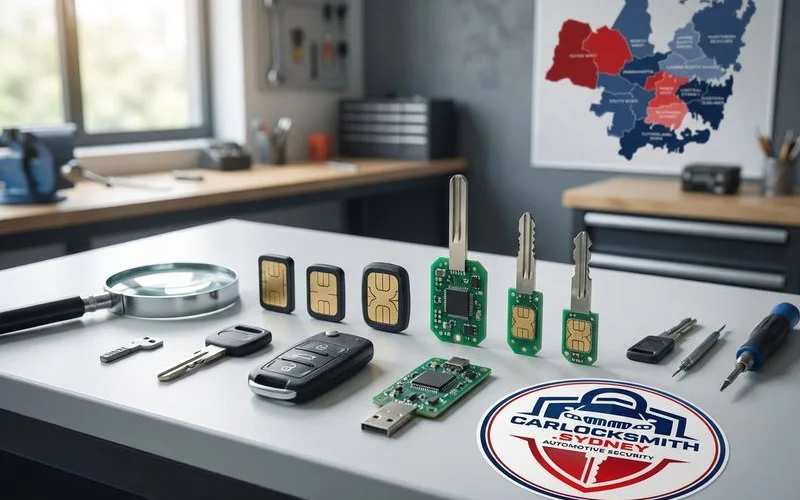
- Glass Ampoules: These look like tiny glass pills. They are common in older European cars and are fragile.
- Carbon Wedges: These look like small pieces of black plastic. They are much more durable and resistant to drops.
- Integrated Circuits: In modern remote flip keys and smart keys, the transponder is often soldered directly onto the remote control circuit board.
Common Transponder Key Problems
Technological failure is frustrating.
We often arrive at a job where the customer thinks their starter motor or battery has died.
The actual issue is often a communication breakdown between the key and the car.
The Security Light Warning
This is the fastest way to diagnose a transponder failure yourself.
Watch your dashboard when you try to start the car.
Most vehicles have a security light (often a padlock icon, a key icon, or a red dot).
- Normal operation: The light turns off immediately when the key is turned.
- Transponder failure: The light flashes rapidly or stays solid red.
Physical Damage to the Chip
Keys get dropped, thrown, and submerged in water.
We see many glass transponder chips (common in older Holdens and VWs) that have shattered inside the key shell after a drop on concrete.
The key looks fine on the outside, but the internal antenna is broken.
Coil Deterioration
The antenna ring around your ignition switch can weaken over time.
It may fail to generate enough power to “wake up” the chip in your key.
This often results in intermittent starting where the car works on the third or fourth try.
Aftermarket Key Failures
Buying cheap keys online is a gamble.
Many generic keys sold on marketplaces contain “clonable” chips that are not compatible with diagnostic programming equipment.
We recommend using OEM-grade or high-quality aftermarket chips (like those from Silca or KeyDIY) to ensure longevity.
Transponder Key Programming Methods
You cannot simply “sync” a new transponder key by pressing buttons on the remote.
Programming the immobiliser chip requires writing data to the car’s Engine Control Unit (ECU) through ECU immobiliser programming.
We utilize three main methods depending on the vehicle’s age and complexity.
1. On-Board Programming (OBP)
This is rare in modern cars but common in older models.
Some vehicles allow you to program a spare key if you already have two working master keys.
The process involves a strict sequence of inserting keys and opening doors, often called the “pedal dance” in the industry.
2. OBDII Diagnostic Programming
This is the standard professional method.
We connect a specialized tablet (such as an Autel IM608 or Zed-FULL) to the OBD port located under your steering wheel.
The tool bypasses the security wall, pulls the PIN code, and forces the car to accept the new key’s digital signature.
3. EEPROM and Bench Programming
Sometimes the car is “locked down” or all keys are lost.
In these cases, we must physically remove the immobiliser module from the car’s dashboard.
We then solder wires directly to the microchip on the circuit board to read the data and generate a working key file.
What You Should Know as a Car Owner
Being informed can save you hundreds of dollars.
We believe every driver should understand these four facts about their keys.
- The “Valet Key” Limitation: If you bought a used car with a grey key, it might be a valet key. These often lack the permissions to program new duplicates.
- Battery Myths: Changing the battery in your key fob fixes the remote buttons. It does not fix the transponder chip. The chip works even if the remote battery is dead.
- The “All Keys Lost” Premium: Making a key from scratch when you have zero working keys is labor-intensive. It requires picking the door lock and resetting the computer.
- Spare Key Savings: Duplicating a key while you still have a working original is significantly cheaper than emergency generation. See our guide on whether getting a spare car key is worth it.
The Cost of Transponder Key Services in Sydney
Prices vary significantly based on encryption levels.
We have compiled this table to give you a realistic idea of current market rates in the Sydney metro area.
These costs reflect the specialized equipment and licensing fees required to access manufacturer security servers.
| Service Type | Estimated Cost (AUD) | Why It Costs This Much |
|---|---|---|
| Spare Key (Clone/Copy) | $150 - $350 | Quick process. Uses an existing key to copy the data. |
| New Key (Programming Only) | $80 - $200 | Assuming you have the cut key. Covers labor and machine use. |
| All Keys Lost (Standard) | $350 - $600 | Requires travel, lock picking, and code extraction. |
| All Keys Lost (High Security) | $600 - $1,200+ | European cars (BMW, Merc) requiring module removal. |
| Remote + Transponder Combo | $250 - $550 | Includes the remote locking circuit board and chip. |
Why Locksmiths vs. Dealerships?
Dealerships often require you to tow the vehicle to their service center.
They may also need to order a key from overseas, which can take weeks.
We carry stock in our vans and come to your location, typically resolving the issue in under an hour.
Understanding these systems turns a stressful lockout into a manageable situation.
It allows you to ask the right questions and ensure you are getting the correct security solution for your vehicle. To understand how transponder keys compare to newer proximity systems, read our smart key vs transponder key comparison.
Looking for this service?
View our transponder key programming service →